Phuktal Monastery, Zanskar
About Phuktal Monastery, Zanskar
Far From City: 111 kms from city center
Cost:
About Phuktal Monastery, Zanskar
Weather:
Time Required:1-2 hours
Open Time:6:00 AM - 4:00 PM
Cost:No entry fee
History of Phuktal Monastery
Built around 2,550 years ago, the Phutkal Monastery finds itself around a natural cave believed to receive footfalls of several scholars, sages, monks, and other preachers. Jangsem Sherap Zangpo is the founder of the present Gompa who established the same during the 15th-century. He was the disciple of Je Tsongkhapa, founder of one of the newest schools of Tibetian Buddhism, Gelug. There is also a stone tablet which serves as evidence to Alexander Csoma de Korös' stay between 1826 and 1827 at this place while he was working on an English-Tibetan dictionary.
A legend of three brothers, Dangsong, Pun, and Sum, who had supernatural powers, and Zangpo is very famous in the history of the Phutkal monastery. The three of them used to impart the teachings of Dharma at the monastery. As Jangsem Sherap Zangpo visited Phutkal, they entrusted the place to him and left. With his powers, Zangpo made a spring to run from the cave, making a tree grow on the top and making it larger. Moreover, it was under his shelter of mind that the monastery was constructed.
Not only this, the monastery has many other facts stored in his heritage history. It is said that the earliest residents of this honeycomb monastery were sixteen Arhats who were great followers of Buddha's teachings. Many other legendary scholars, teachers, and translators such as Phakspa Nestan Dusdan, Zanskar Lotsawa Phagpa Sherab, Lama Marpa Lotsawa, and Padmasambhava visited and stayed for weeks and months here. A French director, Marianne Chaud has made a documentary upon the life of monks living around the monastery.
Structure Of Phuktal Monastery
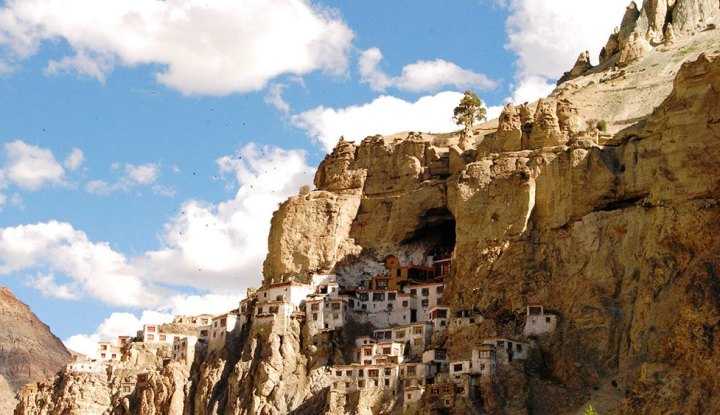
The unique entrance of the Phuktal monastery is constructed with mud and timber. It is made in a way that it depicts the image of a cave. The remote location of this monastery, above the cliff face of Lungnak, a major tributary in Ladkah, is ideal for their meditational activities. At present, it consists of three small and one big prayer rooms, a library for teaching purpose, a kitchen, guest rooms for visitors, the house of approximately 70 monks, and the main temple. One can find the image of 16 earliest legendary followers of Buddha on the walls of the cave. Frescoes and ceiling are decorated with an old chapel which is one of the tourist attraction.
Festivals at Phuktal Monastery
Festivals form an integral part of the Phuktal Gompa. The celebrations are an occasion for local monks to interact with other villagers. By this, they wish to preserve the age-old traditions, spreading Dharma. Below is the list of some major festivals celebrated at the Phuktal Monastery. Moreover, the dates may differ when compared to the Gregorian calendar as the Tibetans have a lunisolar calendar.
1. Smonlam
Chenmo:Also known as Monlam Chenmo, this Great Prayer festival is one of the most significant Tibetan Buddhist celebrations of the year. It marks the beginning of the New Year. Falling towards the end of February and the beginning of March, ceremonies are taken forward for the wellbeing of people and continued world peace. A vast number of people visit the monastery to cherish the atmosphere of festivities.
2. Chonga Chodpa:Celebrated in the first week of March, this festival is a harvest ceremony. Torma is a unique statue of the deity created by the monks. Carefully prepared with barley flour and butter, the villagers later worship it. People dedicate themselves to a devotional mode, and prayers take place.
3. Yarnas:Held between July and mid-September, the festival is also called as the Varshavas Ceremony. The monks live in confinement within the monastery and some limited areas to organise and perform special daily rituals and pujas. These pujas take place for the achievement of good karma over plants, insects and other microorganisms. The devotees also fast in the name of the sacred power. The entry of visitors is also restricted. If they wish to enter, they are supposed to take permission from the head Lama.
4. Gadam Nagchod:The Lightning Ceremony, which is the other name of this festival, is held during the beginning of December. It marks the death anniversary of Je Tsongkhapa who was the founder of a Tibetian branch, Gelug.
Trekking to Phuktal Monastery
An adventurous trek in Zanskar Ranges ends with complete peace and solitude at Phutkal Monastery. This trekking expedition is a test of your grit which takes you through the indescribable beauty of the surroundings. A straight path naturally eroded with sculpted rocks, brings you to one of the oldest monasteries in India. Daunting, enigmatic, enchanting- the feeling of this trek is mesmerising!
For the trek, reach Anmo village from Padum via taxi. It serves as the lowest trekking point and has three stupas marking the beginning of a tiresome yet positive journey. The way to Phutkal is full of steep and narrow passages, and hence you need to be very careful. As you trek forward in an hour or two, you manage to reach Cha village which is the midpoint of the passage atop. From here, it is a 6km trek to the monastery which can take 3-5 hours depending on your speed and strength.
Usually, people prefer Cha as it falls on the shorter route. The trek consumes almost a whole day, but as you reach the monastery, which is an amalgamation of Tibetan and Buddhist carvings, art, and scriptures, every ache comes to an end. If you wish to add some more adventure, you can make your way through Purne, a village situated across the river Lungnak which comparatively is a longer route (Padum - Rera - Pepula - Purne - Phuktal). It takes two days from this route to reach the monastery.
Phuktal Monastic School
Following the Buddhist teachings of sharing and delivering knowledge, the Phuktal Gompa has built a school which manages to cater children from the nearby villages. Set up in 1993 by Geshe Lharampa Nagri Choszed, it provides education free of cost. It has a curriculum which has both the traditional and modern teachings. The monastery bears every cost from rooms, study material, food, and other services. It even brings sponsors for the temple of education. Situated near the monastery, the monastic school provides a ray of hope to children residing in the areas that are far fetched from towns. It is an attempt to make students capable of living a quality life.
How to Reach Phuktal Monastery, Zanskar
There is no direct transportation available to the Phuktal Monastery. It requires you to trek for several hours to reach here. At first, you need to reach Padum from where it is advisable to take a taxi to reach the Anmo village. Further is a trek that leads you to the monastery. It depends on you if you can finish it in a day or two. In between Cha is the stopping point.
Another route is from Paduma to Rera and further a trek from Purne to the monastery. Pepula is the midpoint between Rera and Purne.
It is advisable to go with a tourist guide or a local if you wish to reach safely within the desired time.
Top Tourist Places in Leh Ladakh
Shanti Stupa
Tso Moriri Lake
Leh Palace
Khardung La Pass
Magnetic Hill
Nubra Valley
All Tourist Places in Leh Ladakh
Tips
1. No photography is allowed inside the monastery.2. Best time to reach is between the months of July and September as during other months the passes are blocked due to snowfall.3. Start the trek as early as possible in the morning so that you reach the resting place or the monastery before the sun bids goodbye for the day.4. Carry enough food and water that lasts for two days as it is uncertain that you would find some on your way.5. Wear good trekking shoes to avoid any injuries due to slipping. And most importantly be careful!
Photos of Phuktal Monastery, Zanskar
Comments on Phuktal Monastery, Zanskar
Post Your Comment